

Not So Honest Abe
How Lincoln’s February 1 signature, liminal timing, and sacrificial shadow cast a spell across history.

February 1 and the Spell of Lincoln
On February 1, 1865, Abraham Lincoln performed an act that was legally unnecessary but symbolically charged: he signed the joint resolution proposing the Thirteenth Amendment, the amendment that would abolish slavery in the United States.
Congress had passed it the day before.
Lincoln’s signature was not required for constitutional amendments.
He knew this. Everyone around him knew this.
And yet—he signed it anyway.
To a conventional historian, this is a flourish.
To an occultist, it indicates something else entirely.
It is ritual.
February 1: A Liminal Day
February 1 has long been recognized in pre‑Christian Europe as Imbolc, a cross‑quarter festival marking purification, renewal, and the first stirring of light within darkness. It is associated with fire, rebirth, and the breaking of bonds imposed by winter.
At its heart was the goddess Brigid, a fire‑linked figure of fertility whose presence was welcomed with candlelight, purification rites, and offerings to usher in renewal and protection.
Wiccans and Neo-Druids celebrate Imbolc as one of the eight Sabbats in their pagan Wheel of the Year. In folk magic and Celtic lore, it is a day when hidden forces shift, when vows are sealed not by law, but by will.
National Freedom Day
Liminal days matter because they behave differently.
They do not merely record events.
They set them in motion.
That Lincoln chose—or allowed—his name to be affixed to the death warrant of American slavery on this day invites a symbolic reading: the binding of a moral spell, a national intention etched into history at a moment traditionally reserved for occult transformation.
The law may not have required his hand.
Symbolism did. And then it required his life.
Lincoln the Mystic
Lincoln himself was no stranger to the uncanny. He spoke openly of prophetic dreams, including the now‑famous vision of his own death.
(The most famous martyr in 2025 also had premonitions of his death.)
Lincoln was deeply drawn to biblical cadence, apocalyptic imagery, and what he called the “mystic chords of memory.” Friends and contemporaries noted his belief in fate, though he framed it in sober, almost reluctant language.
By signing the amendment on February 1, Lincoln was doing something profoundly old‑world: placing his personal mark at a liminal threshold, anchoring a transformation not merely in law, but in time and meaning.
Occult interpreters have long noted several unsettling convergences:
February 1 sits opposite August 1 (Lughnasadh), another ancient festival tied to sacrifice and kingship.
The act came only weeks before Lincoln’s assassination, reinforcing the archetype of the sacrificial ruler.
His signature can be read as a final consecration—an offering made with full knowledge of the cost.
The Spell Completed
When Lincoln was assassinated publicly in April, many Americans unconsciously mythologized him not merely as a president, but as a martyr. In esoteric terms, February 1 marks the moment the spell was cast; April 14, the moment the price was paid.
February 1 thus stands as:
The day slavery was symbolically unbound
A ritual act disguised as bureaucracy
The moment Lincoln stepped fully into legend
Lincoln and the Masonic Question
Though Abraham Lincoln never formally became a Freemason, his relationship to the craft is significant. In 1860, shortly after his nomination for president, he applied for membership in Tyrian Lodge No. 333 in Springfield, Illinois. He later withdrew the application, fearing that joining during an election campaign could be perceived as a political maneuver. He informed the lodge that he intended to resubmit after completing his presidency.
That would not be necessary.
On April 17, 1865—three days after his assassination—Tyrian Lodge passed a resolution honoring his decision, stating that his choice to postpone membership “lest his motives be misconstrued, is the highest degree honorable to his memory.”
Though never initiated, Lincoln was widely regarded by Freemasons as a man who embodied Masonic ideals: faith, hope, charity, equality, and tolerance. Symbolically, he fits the archetype of the moral builder, the “Widow’s Son” who lays cornerstones of freedom even if he never physically holds the trowel.
The Pattern Reappears
Certain deaths do not end. They replicate.
A century later, the pattern returned with uncanny precision.
President Lincoln killed in Ford’s Theatre
Another president killed in a Lincoln made by Ford
Both struck publicly. Both on Fridays. Both shot in the head. Both at moments when the nation believed the danger had passed.
The timelines align too neatly to dismiss:
Elected to Congress: 1846 / 1946
Elected President: 1860 / 1960
Succeeded by a Johnson
Followed by fragmentation, unrest, and moral drift
This is not coincidence. It is recurrence. A calculated script.
Silenced Men, Frozen Narratives
Both assassins carried three-part names. Both were eliminated before trial. Both deaths ensured that the story would never fully close.
Unresolved violence creates gravity.
Gravity bends memory.
Memory hardens into myth.
Sound familiar?
Why the Date Keeps Returning
The occult studies pressure points—dates, symbols, patterns that history revisits when the present begins to rhyme too closely with the past.
February 1 is one of those pressure points.
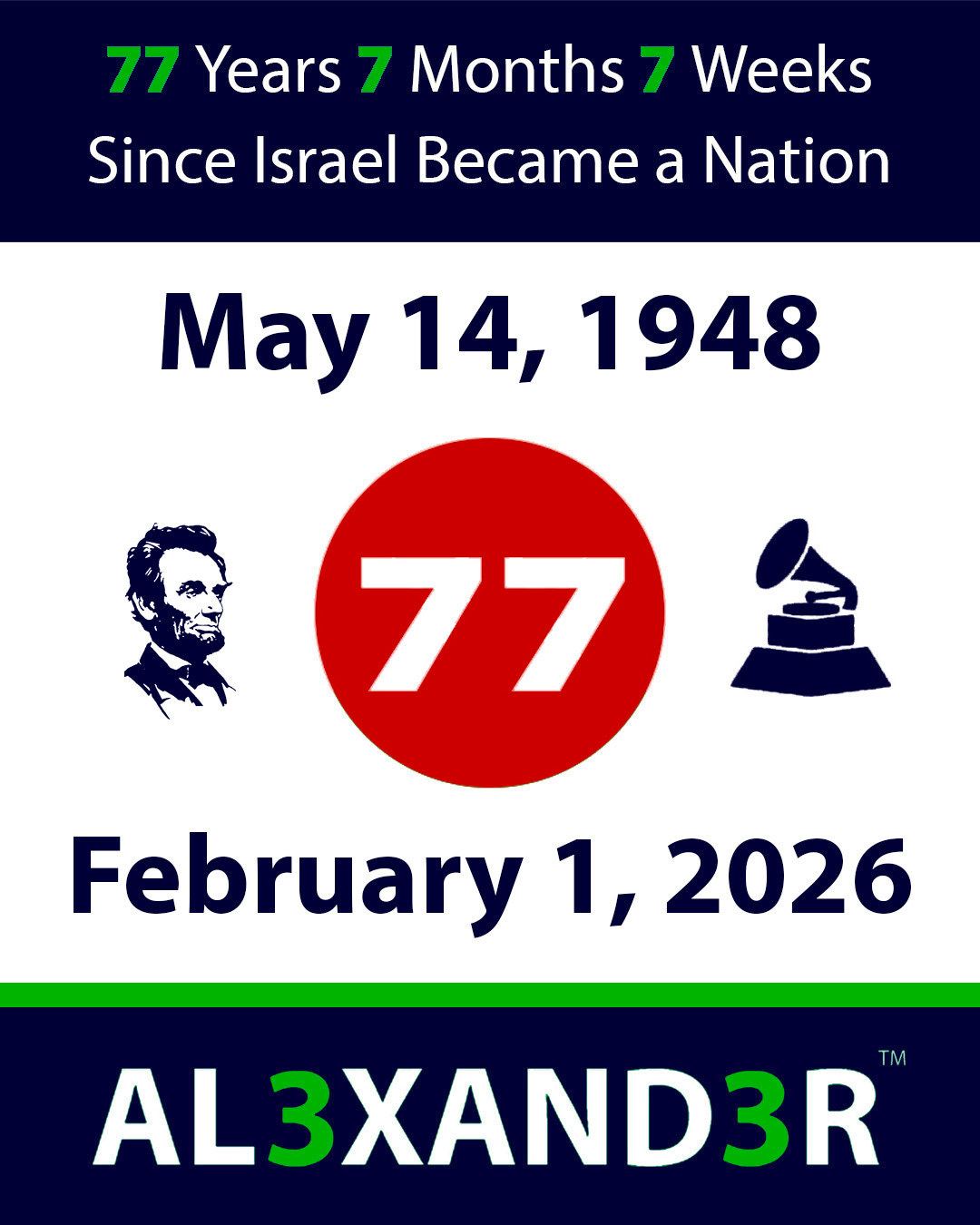
It is also a favorite day for Jesuit rituals since the date can be written as 2-1 and 201 is the Jesuit calling card. On top of that, this year, February 1st also has startling numerology tied to the number 77.
The Unsettling Question
The most dangerous dates are not anniversaries.
They are activators.
When conditions resemble the past closely enough—division, spectacle, moral confusion, public figures elevated into symbols—the old patterns begin to stir.
February 1 does not announce itself.
It does not warn.
It simply waits.
…and now I’m wondering whether February 1 is just a date—or a trigger.
I’m Gr8ful.